Thursday, 12 September 2013

Syria


SYRIA

The House of Commons managed to make one of its occasional sensible decisions last week by voting against the government motion to support American intervention in the Syrian civil war. It is very rare for the Commons to vote down a government motion on foreign affairs; in fact I believe it is the first time for 200 years; but it is all the more welcome for that. For once we have declined to be dragged along on American coat-tails and to get ourselves enmeshed in yet another Middle Eastern imbroglio, the consequences of which are unforeseeable but very possibly catastrophic, as per the Iraq fiasco.
There are many good reasons not to support the bombing of Syria. For starters it is still by no means certain that it was Assad’s regime that was responsible for the chemical attacks on a Damascus suburb that has provoked Obama’s ire. It is hard to see why Assad would do the one thing that would bring American (and perhaps British) intervention on the side of the rebels, given Obama’s comments about the use of chemical weapons being a “red line” last year. Assad must surely realise that that is the only action on his part that would seriously jeopardise his position. He appears to be gaining ground in the civil war, but American bombing of military installations and other targets would of course seriously undermine his capacity to continue the war. And to what purpose? Chemical weapons are very terrible things, which is why they are banned under international law, but they are surely no more effective in subduing a civilian population than conventional weapons. I cannot really buy Cameron’s claim in the Commons debate that he is “testing the West’s resolve”. On the other hand rebel groups do clearly have an incentive to use them if they possess them (and it is not absolutely clear that they don’t despite western insistence on this point). The British, the French and the Americans have all insisted that the Syrian regime was responsible, but then they would, wouldn’t they? No neutral country, i.e. one that is not itching to attack Assad, has yet asserted this, and anyway the intelligence about all of this is still very hazy. We have not even yet had the UN inspectors report, which will surely answer a lot of questions – though not necessarily the identity of the culprits. It may well be that Assad was responsible, but let’s try to establish this point first before rushing into precipitate action.
But let us assume that Assad was responsible for the attacks. Does this justify military intervention? Despite all the talk of precision bombing and surgical strikes, etc, etc, it is almost certainly the case that heavy attacks by cruise missiles would result in substantial civilian deaths. So we would be punishing Assad for killing civilians by killing civilians ourselves. It is just that our weapons would not be chemical ones, but civilian deaths are civilian deaths however they are brought about. And it is hypocritical, to put it mildly, for western powers to rail against chemical weapons use when they themselves have for decades manufactured and stockpiled them. The Americans used white phosphorus in Iraq, which I believe is a chemical weapon in all but name.
We cannot calculate what would be the effect of heavy strikes against Assad, and what effect that might have on the balance of forces in the country. Would they be so heavy as to tip the balance in favour of the rebels, in which case it would amount to an attempt at regime change, the thing that the British and American governments have almost certainly desired, for whatever obscure geo-political reasons of their own, all along. But who would that enthrone in Syria? The Free Syrian movement of course strenuously disavows any connection with Al Qaida and other militant Islamic groups, but the situation on the ground is evidently so complex, and there are so many different contending groups that militant Islamists would surely be empowered in parts of the country. Conversely, if the American bombing were relatively light, i.e. punitive and deterrent, but not preventive, it might be utterly ineffective in having the desired deterrent effect. What if, some way down the line, further chemical atrocities were perpetrated? The US could scarcely just shrug its shoulders and go away after having committed itself to action. It would result in further and heavier bombing, which might still prove ineffectual. It should be remembered that in 1998 Kosova and Serbia endured very intense bombing for 75 days without yielding, and that ultimately it was only the threat of a land invasion that forced Milosevic’s surrender. Would there ultimately have to be a threat of a land invasion in Syria. Ever heard of mission creep.
And it has to be said that the neo-cons and liberal interventionists who advocate bombing are always highly selective in their choice of enemy. It is currently Assad, but what about the numerous instances of attacks on civilians elsewhere in the world, not least the deliberate shooting of thousands of unarmed protesters in Egypt by the new military regime there. Not a peep out of the neo-cons about that, nor from Obama for that matter – in fact the US government still refuses even to admit that what happened in Egypt was a military coup, because that would mean they could not legally supply weapons to them. It looks very much as if “the West” is taking the side of the Sunni powers Egypt, Saudi Arabia and Qatar against the Shia powers, Syria and Iran, in the Islamic power struggle that seems to be taking shape in the Middle East at the moment.

I strongly suspect that, contrary to appearances, Obama is not really at all keen on intervention against Syria, given that he was elected on a platform to extricate the US from its entanglements in Iraq and Afghanistan and that the very last thing he wants is yet another US war in the middle east. But he painted himself into a corner by denouncing in advance the use of chemical weapons last year, and now feels honour bound to follow through on this, especially given the pressure he is under from Senate hawks like McCain to take action. After all, before now it was Cameron who was desperately trying to inveigle Obama into action, not the other way around. He did not seem all that strident in his rhetoric, unlike John Kerry, who was breathing fire last week, and it may well be that he is also under pressure from within his administration from Kerry and others in the State Department. His decision to seek Congressional approval for any action was understandable from a political standpoint (though not necessary under the Constitution) but he must surely not have been unaware of the dovish mood in the House and in the country at large and the strong possibility that he might be defeated, just as Cameron was in Britain. Is that what he really wanted? Maybe. It would get him off the hook because he could scarcely seek Congressional approval and then go ahead if he failed to get it.
And now the Russian initiative has given him another life-line. Obama was careful not to sound too ready to grab it in his address to the American people yesterday, not wanting to sound gullible or weak, but I fancy he is breathing sighs of relief and hoping that the Syrians will be sufficiently compliant with any chemical handover programme for him to announce “job done” at some time in the future, without any bombing. The claims that Putin is “playing him like a fiddle” overlook the point that Obama may see the whole thing as to his advantage, proving that diplomacy and the threat of force are more effective than the use of force. And Britain can congratulate itself on having divorced itself from any of this at the outset.


Tuesday, 27 November 2012

The Politics of the Rope


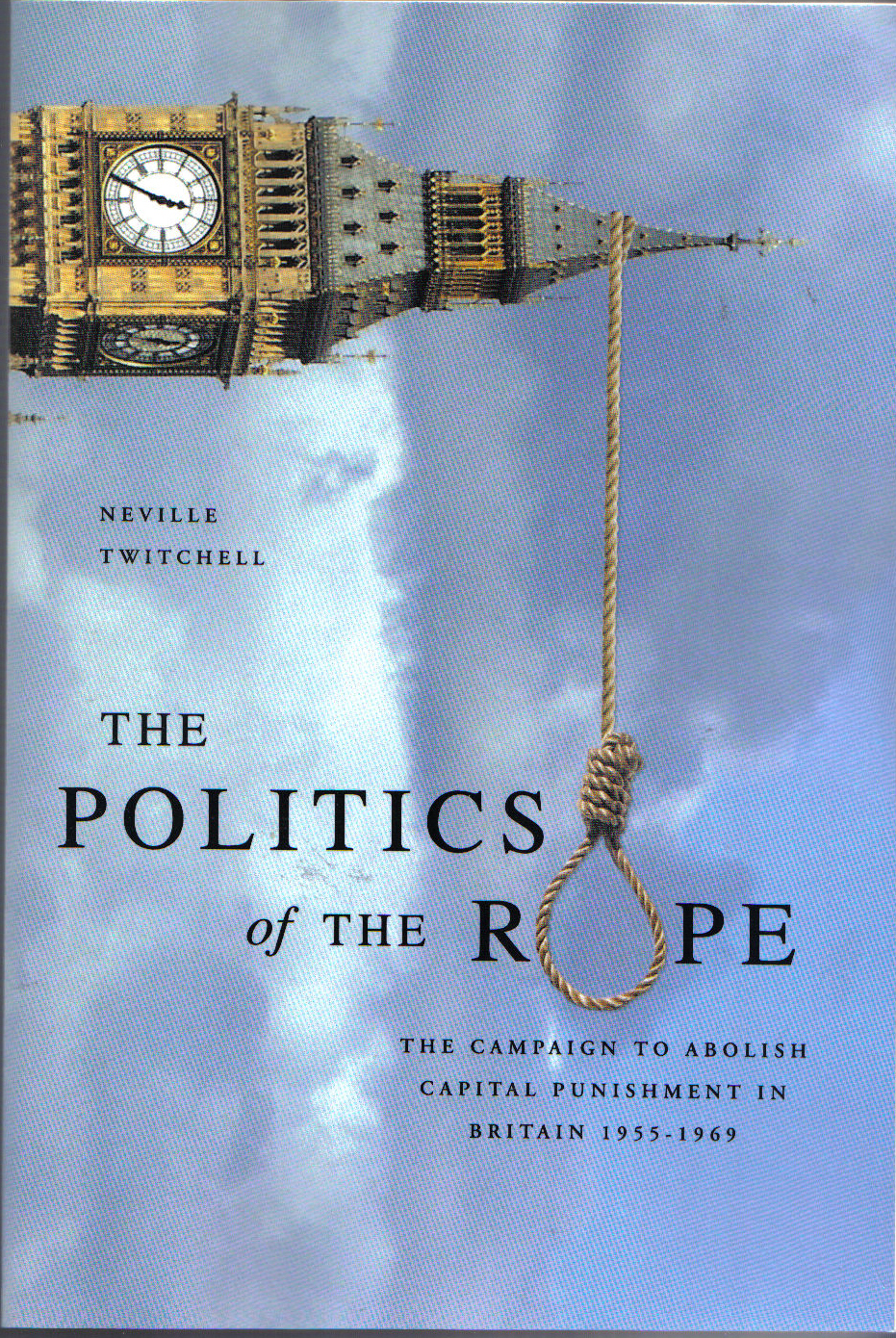
My book The Politics of the Rope: The Campaign to Abolish Capital Punishment in Britain, 1955-69 has just been published (Arena, softback, 400 pp., October 2012, £18.99). It is essentially the long version of my PhD thesis of the same title, which I have been trying to get published for a long time. It is a work of political history, being an account of the campaign to abolish hanging in this country, focusing more or less completely on the critical years from the mid 1950s to the late 1960s. It deals with the campaign from a very broad perspective, taking in the Parliamentary manoeuvring and pressure group activity, but covering also social, religious and cultural factors, and setting it in the context of the liberalising mood of the times and the raft of conscience legislation on abortion, divorce and homosexuality . It seeks to demonstrate the way in which social and cultural trends can flow into and out of politics. 

It is based chiefly on primary sources, including much material hitherto largely overlooked, including the papers of the main abolitionist pressure group, much Home Office documentation drawn from the National Archives, and the papers of the chief political parties. 


It includes a discussion of the treatment of the hanging issue by the mass media, especially television, radio, film and theatre, and its coverage by the press, both popular and specialist; and draws, inter alia, on the written archives of the BBC; and demonstrates the way in which the question was woven into the fabric of popular culture. There is an analysis of the activities of the various professional bodies representing the police, the prison service and the legal profession and how important they were in influencing the course of political debate, and there is a lengthy discusion of the role of the various churches and how their position evolved during the course of the fifties and sixties. There is a chapter on opinion polls and the importance, or unimportance, of public opinion, and there is an analysis of the significance of the various miscarriages and causes celebre of the era, particularly the cases of Timothy Evans, Derek Bentley and Ruth Ellis and to what extent they weighed on public opinion.

Later chapters deal with the governmental manoeuvring over the entrenchment of abolition and the attempts to beat off a strong campaign to restore hanging at the earliest opportunity in the wake of a number of high profile murder cases, attributed, rightly or wrongly, to the abolition of hanging; the tangentially associated campaigns about other "conscience" issues such as the legalisation of homosexuality, the liberalising of divorce and abortion, the abolition of theatre censorship and the relaxation of the Sunday Observance laws. There is an analysis of the reasons for the ultimate success of the campaign despite consistently adverse public opinion and in the teeth of institutional hostility from the judiciary, much of the Conservative Party, the police and prison service and much of the right-wing press.

 The book is available on Amazon and from most major booksellers.


Monday, 19 March 2012

The Iron Lady

The Iron Lady shows signs of metal fatigue

I finally got to see this much hyped film recently. It is undeniably an interesting and even an intriguing film, though very far from being a great or even an outstanding one. I say this because whilst it undoubtedly leaves a deep impression on the mind and features a very remarkable performance from Meryl Streep as the eponymous ferrous female, the film has too many deep and significant flaws.
As is well known the film depicts the now aged and infirm Lady Thatcher as the framing device within which we see her development as a person and as a politician. Streep’s performance has not been over praised. It is the most extraordinary portrayal of a real and living person that I have ever seen, almost eerily so. As the aged Thatcher it is at times hard to believe that we are not watching the real person, so brilliant is her impersonation, with its mixture of stridency and dithering, and as the younger, prime-of-life Thatcher, she is equally impressive, conveying the brisk, bustling authority and unflinching certainty. This no mere impression a la Rory Bremner, Jon Culshaw, or Ronnie Ancona, but rather the production of a believable individual by inhabiting that person’s universe. The once iron lady is now suffering a severe case of metal fatigue, and her hold on rationality is uncertain, hard-headed commonsense flickering on and off like a torch with a dodgy battery, as she fights off the attentions of her now dead husband. The propriety of this approach to the portrayal of a still-living person has of course been questioned, but it is a compelling, though hackneyed narrative device.
But whilst the performances are outstanding the problem with the film really lies with its politics, and the extreme difficulty of trying to encapsulate a long and tempestuous premiership within the confines of a ninety minute film. Clearly the film-makers (director Phyllida Lloyd and screenwriter Abi Morgan who wrote The Hour) had decided not to focus on any single aspect of the Thatcher premiership such as the miners strike, the Falklands War, or the Brighton hotel bombing, as one might have imagined that they would do, and instead we get a panorama of her years in power, ranging from industrial strife, to the Falklands, to Cabinet arguments over economic policy, to Europe, the Brighton bombings and the IRA, the Cold War, etc, etc. You name it and it is there, briefly covered and mainly in the form of contemporary archival news footage, with perhaps the odd little scene involving Thatcher and a collection of ministers, or a House of Commons scene. This is okay as a sketch of her time in office, but it fails to get to grips with the core of her political beliefs and the reasons why her premiership was so intensely controversial. Did her government transform the country and was this for better or worse? These are the questions that need to be addressed, but aren’t really, and cannot really be in a ninety minute film.
The political scenes are reasonably well handled, though often not totally convincing. There is the usual rather stodgy depiction of the Commons as a bear garden stuffed with braying backbench MPs, though as so often its authenticity is undercut by making it a little too homogeneous in composition, mannerisms and behaviour. In particular literally every singly Tory MP is male, whereas in reality there was, even then, a smattering of females on the backbenches (on both sides), and it has apparently been admitted by the film-makers that this was done deliberately so as to emphasise how she stood out in sharp relief from the broad mass of her party by virtue of her “femaleness”. It may be an effective dramatic device, but it is factually incorrect and therefore irritating to a political anorak such as myself. Also the Cabinet scenes, or scenes of meetings with ministers, are moderately convincing but the line-up is curiously selective. We get a lot of Sir Geoffrey Howe, for example, right through the premiership, but little of some other equally prominent Cabinet members. In particular I failed to spot Willie Whitelaw at all, which is an extraordinary omission given not only that he was deputy prime minister, and the man she defeated for the leadership but also of vital importance to the success of her premiership, especially in its early days when relations with much of the party was rocky to say the least. He was the chief representative of the “wets” in the party, and a man whose continued loyalty was vital for her secure continuance of backbench support. As she famously said, in an inadvertent witticism, “Every prime minister needs a Willy”. Others too are strangely AWOL, unless I missed them in the multiplicity of characters who appear, such as key acolyte Norman Tebbit, Chancellor Nigel Lawson and, most extraordinary of all the absences (again unless I missed him), Sir Keith Joseph, her chief political mentor. There is very little evidence of any leading Labour Party figures either, with just Michael Foot appearing in one lengthy Commons scene, but where was Wilson, Callaghan, Kinnock or numerous others? This may have been because there wasn’t the time or space to accommodate every leading figure – the cast after all changed greatly over the course of her eleven year premiership - but may be because of the political ignorance of the filmmakers, unaware of the key significance of certain politicians to Thatcher’s political development. Maybe they were there but relatively inconspicuous with Howe chosen, for some reason, to stand in as the permanent representative of her Cabinet, and portrayed as rather feeble and pusillanimous.
If so, it is not only a failing regarding authenticity but indicative of the film’s total failure to grapple with the hard politics of the times. Where were the arguments over economic policy, tax and spending, privatisation, monetarism, inflation, etc?  Admittedly these are hard concepts to deal with in a ninety minute film, and one starts to wish for a lengthier treatment which only television can give. Indeed such treatment has been given in such BBC offerings as “Margaret Thatcher: The Long Walk to Finchley” (2008), directed by Niall MacCormick, written by Tony Saint and starring Andrea Riseborough, dealing mainly with her rise, and “Margaret” (2009), directed by James Kent, written by Richard Cottan and starring Lindsay Duncan, about her fall. Admittedly the former looks and sounds a bit like “Carry On Up The Conservative Party”, but never mind. Or indeed the “Falklands Play” (2002), directed by Michael Samuels and written by Ian Curteis, where she is portrayed very effectively, though without any attempt at physical impersonation, by Patricia Hodge, dealing with a single decisive issue of her career in great depth and providing a very effective drama about what was arguably the turning point of her premiership.
There are other liberties too. Mrs Thatcher was certainly not present at the murder by car bomb of her mentor Airey Neave, and to show her rushing to him after his death is a dramatic liberty much too far and more in keeping with the conventions of a Hollywood blockbuster than a serious British film dealing with real-life events. It would have been just as effective, and in keeping with the truth, to have shown her horrified reaction on camera when she was informed of his death during the course of the 1979 election campaign. Even Mrs Thatcher did not wear a hat in the chamber of the Commons, where headgear is strictly prohibited. Another error, and one that I feel may be inadvertent, unlike the aforementioned, is her “makeover session” with Gordon Reece and Neave, which did not take place until she was well into her spell as Leader of the Opposition, and not before her election to the leadership as the film suggests. And what of the odd bit of dialogue in this scene where, as she prepares for her leadership bid against Heath, she is saying to Reece and Neave that she did not imagine that she would ever be prime minister! Why then was she standing for the leadership? Did she envisage leading the Tories to electoral defeat if she gained the leadership? This makes no sense politically or dramatically, and is at odds with the whole tenor of the film, which correctly portrays her as utterly convinced of her right, duty and capacity to lead the country.
There are also the obligatory series of vignettes of her early life, her adolescence, her relationship with her parents; very warm and intimate with her revered father, the legendary Alderman Roberts, and a tad distant with her mother, and mocked by schoolmates for being a swat. Then we follow her entry into politics as the very young Conservative candidate for Dartford, and her meeting with the young Denis Thatcher and his evident infatuation with her. We are invited to believe that she was patronised and looked down upon by the, then, patrician and male party grandees, sparking her determination to succeed in spite of their scorn. Again, it is debatable as to how true a representation this is of Tory internal politics at the time. The fact remains that she was nominated as Tory candidate for Dartford in 1951, at the age of twenty-five and then for the safe Tory seat of Finchley for the 1959 general election, at the age of thirty-four or younger, so the prejudice in Tory circles against a petit bourgeois woman cannot have been that great. Denis is portrayed in these early scenes as a bit of a buffoon, and then again as the spectre haunting Margaret in old age as a tiresome prankster. This is at odds with what we know of the tough, hard-headed, and very right-wing businessman we know him to have been.
There are affecting scenes as we see the aged Margaret pore over home recordings of her time playing with the children, Carol and Mark, as she symbolically runs the film backwards, murmuring about how “they grow up so fast”. We see the old lady fight her way back to sanity with the help of daughter Carol (well played in a low key by Olivia Coleman), ultimately dismissing the spectre of Denis, getting rid of his clothes, a leitmotif of the film, and struggling to regain her grip on reality, a battle we are invited to understand she wins.
This is an extraordinary take on a remarkable life, but then the scenes of her dotage could in a sense be anyone’s, so why pick on her?

A beguiling but unsatisfactory film.

19th March 2012


Thursday, 22 September 2011

The Hour


The Hour is 360 minutes too long
The Hour is a bold attempt on the part of the BBC to weave together a suspense thriller, a political drama and a social satire to produce a work that provides a commentary on the state of British society in the mid-1950s, as reflected and refracted through the camera lens and its treatment of current affairs, and which tries to explain the way in which society and television was fighting to break out of its straightjacket. Unfortunately it does not really succeed and though one can see what the producers were trying to achieve it falls lamentably short.
The politics of it does not convince, and nor does its depiction of television in this era, which was still hidebound by the conventions and technical limitations of the time, in particular the fourteen day rule which precluded the coverage of political questions which were going to be debated in Parliament within a fortnight. This was mentioned by the characters but then seemingly disregarded. Of course, the point was that they were smashing through the barriers, but it nonetheless fails to convince. It was indeed the Suez crisis that brought about the effective demise of the 14 day rule, but as a result of the pioneering efforts of Granada and ITV (only brought into being one year previously) not the BBC.
More generally the whole ambience of The Hour (both the show itself and the show within the show) is that of a later era, the mid-sixties perhaps rather than the mid-fifties. When I first saw the trailers for the show I guessed from the look of thing, the graphics, the central characters, etc that it was circa 1963 and that the show within the show was something akin to That Was The Week That Was. Television current affairs was simply not that spontaneous, rebellious or innovative in 1956, and the show fails to convey the sheer stodginess of life at that time in Britain. There are quite a few seeming anachronisms, particularly in speech and manners, though admittedly one can never being completely sure of that, and some things jar horribly. It is inconceivable that a presenter would be brought on impromptu to do an interview in shirt sleeves. Both Romola Garai and Ben Whishaw look wrong for the period, and seem vaguely as if they have been time-warped back from sometime in the 1960s. Again this may be deliberate on the part of the programme-makers, to demonstrate that they are trail-blazing, avante garde figures, but I doubt it.
Moreover, much of the plot was obscure and failed to make any sense, and some scenes were plain ludicrous such as the fight scene in episode 3 between Whishaw (Lyon) and the MI6 chappie within the hallowed precincts of the Beeb itself. (Incidentally MI6 deal with espionage overseas not counter-espionage within the UK which is the remit of MI5). Characters are imbued with astonishing powers of prescience and political erudition way beyond what they would have possessed in real life (a common failing in historical dramas). Lyon has already managed to identify John F Kennedy as a major figure, and the characters greet Nasser’s nationalisation of the Suez Canal as a seminal event long before its real significance was apparent (I fancy that Suez was very much a slow burner as a political issue). This is probably designed to demonstrate the character’s insight but it merely reveals the way in which the drama has been written with the benefit of hindsight and the script’s failure to capture the real essence of the way people thought and felt during the period in question.
The oft-made comparisons with Mad Men merely serve to underline the superiority of that series in almost every respect. All in all the hour is a bit of a waste of time - 360 minutes of it to be precise.   


Bobby Fischer Against The World

Bobby Fischer Against The World

Directed by Liz Garbus (2011)
HBO co-production
Running time 91 minutes plus special features 28 minutes approx.
Available on DVD from Dogwoof, £9.99

This is the much-hyped documentary about the life and career of Bobby Fischer, told by means of contemporary interviews with friends, colleagues, journalists, organisers, etc, interleaved with archival footage and photos, to create an intriguing portrait of the most controversial and, in the view of many, the greatest chess player in the history of the game. I had heard a great deal about this film and wasn’t quite sure what to expect but I was certainly not disappointed. The centrepiece of the film is inevitably the famous 1972 world championship match between Fischer and Spassky, around which Garbus weaves the story of his life up to that point and the course of his life afterwards. Of course we all know the story forwards and backwards, and it has been told many times in the numerous books about Fischer and the match, but nonetheless it is still fascinating to watch again the footage of that momentous match and (for those of us old enough to remember the sixties and the seventies) to re-live those times: the world of Nixon, Kissinger and Brezhnev; of Watergate, Vietnam and race riots; above all of the Cold War, for which the match inevitably became a symbol.

There is much footage that I have never seen before, such as Bobby’s appearance on “I’ve Got A Secret”, the US equivalent of “What’s My Line” in 1958, as a callow fifteen year old in jeans and t-shirt, and on talk shows over the years up to his appearance on the Dick Cavett show in 1972, in addition to material often shown. Fischer emerges inevitably as a brash, arrogant, yet complex and tortured soul. We can chart his development as a player and a person from that crew-cut teenager to the smartly suited young man of the 1960s, up to the Reykjavik match, and from that to his sharp deterioration thereafter, both physically and mentally, until his re-emergence in the early 1990s, now as a bulky, lumbering, heavily bearded middle-aged man. The film is, inevitably, a bit light on hard chess content, but nonetheless there is a moderately good account of some of the early games of the 1972 match, such as the “bishop blunder” of game 1 and the masterpiece of game 6, but one cannot expect too much in this regard because the film is surely pitched at a non–specialist audience.

There are fascinating vignettes from people such as Larry Evans, his long time friend and collaborator, and Anthony Saidy who was close to Bobby at the time of the match, and with whom Bobby was staying in New York. (Saidy looks and sounds like he should be in the Sopranos - if he made me a draw offer I wouldn’t refuse!) Kasparov inevitably makes an appearance as an interviewee, and is predictably scathing about the 1992 re-match, just as Fischer was contemptuous of the Kasparov-Karpov matches of the 1980s which he insisted – without ever providing any evidence – were fixed. There is intriguing material about his mother, Regina, a remarkable woman, suspected of Communist sympathies and on whom the FBI had a bulky file, and whom he subsequently rejected.

There is much material on the post-1972 Fischer, who effectively retired from chess by making impossible demands on organisers and arbiters and became a recluse, and who then, after his sanctions-busting re-match against Spassky in Yugoslavia in 1992, became an enforced exile, in various countries. Searching for Bobby Fischer became a furious pastime for sections of the media. Then there came his virulently anti-Semitic and anti-US comments, particularly after 9/11; and finally his arrest in Tokyo at the behest of the US, the offer of citizenship from Iceland, his move there, and finally his death in 2008 at the age of 64.

The special features include an item on the battle over Fischer’s estate between his Japanese wife (which seems to have been a marriage of convenience), his Filipino girlfriend and her daughter (whom she claims implausibly to be his) and his nephews, which is still being contested in the Icelandic courts. I have one slight gripe. The photograph of Fischer on the front cover of the DVD (and which is used in all the promotional material) has been accidentally reversed (fortunately he is not sitting at a proper chessboard so there are no board reversal issues).

There is a great deal of riveting archival material here, and some penetrating insights from a large cast of chess players, friends and commentators. It raises many questions, not all of which it can answer. Did Fischer desert chess after 1972 for fear of losing? Was he clinically psychotic towards the end of his life? What was the effect of his mother on his early development as a boy and did his monomaniacal concentration on the game warp his character? But, all in all a fascinating study of tormented genius, grippingly told.

Incidentally I have heard that there are plans to make at least two other films about Fischer. Are these documentaries or feature films? If the latter then I have always thought that James Woods would be ideal for the role of Fischer, due both to his facial and physical resemblance and his line in brash, arrogant characters.


Friday, 4 February 2011

The King's Speech


I have now finally got to see this much hyped film. As I expected from the trailers and from the various comments and reviews I have read the film is rather a travesty of history, and utterly misrepresents the characters and events of the time. No surprise there then, since it is rare for a commercial feature film to portray historical events with any degree of verisimilitude.

I think that Colin Firth is badly miscast as George, and though he struggles hard with the role he fails to convince chiefly because he is physically so wrong - too tall, too good-looking and altogether too commanding a physical presence. Also Helena Bonham-Carter is perhaps rather too pretty and shapely for Elizabeth. Others, too, are physically wrong for the roles they play, such as Baldwin and Churchill. Guy Pearce on the other hand is very convincing as the raffish and devil-may-care Edward (David) and in fact the believability of his portrayal tends to throw into sharper relief the "wrongness" of Firth as George, as for example, in the scene when Edward mocks and belittles him. The whole scene utterly fails to convince. Some of the other parts, however, are well played and a delight, especially Geoffrey Rush who is brilliant as Dr Logue (though I confess I have no idea what he was actually like), and it is interesting to see Ramona Marquez, so amazing in "Outnumbered" as Princess Margaret Rose.

But much more important than the miscastings, is the general tone of the film and its misrepresentations of the political and social realities of the time. Crucially of course is its depiction of attitudes towards Nazi Germany and the looming threat of war. The film credits many characters, but especially George V (a bit of a dimwit by all accounts) with extraordinary political insight and prescience. He at one point foretells and rails against Britain being squeezed, politically, between Nazi Germany and Soviet Russia. The Royal Family are being recruited into the ranks of anti-appeasers, against all the evidence that they were generally rather non-political, and deeply conservative insofar as they were political at all. Certainly one cannot accept the idea of either George V or George VI as arch anti-appeasers. (At least this film was better, in this respect, than an ITV production I recall from a few years ago which has George, quite ludicrously and unhistorically, attacking Chamberlain's appeasement policy in conversation with Roosevelt on his American tour).
The portrayal of Churchill as a supporter of George, when he was a die-hard supporter of the lost cause of Edward, is also egregiously wrong. Many other things jar horribly, such as Baldwin "telling" George that Chamberlain is to succeed him as PM, rather than merely "advising" him as was of course the constitutional position.
Most egregious of all the historical falsities is of course the final scene, which depicts an event which I am fairly sure never happened, namely the broadcast from Buckingham Palace to the nation on the outbreak of war. Of course it is understandable that the film-makers should need a climactic scene, for dramatic reasons, in which the "hero" overcomes the enemy, or in this case, overcomes his own weakness and inadequacy, and moreover does so in the context of using this personal triumph to rally the nation in a time of peril, for otherwise the film would just tend to trail away. But even if we are to accept this dramatic licence, I can scarcely believe that the broadcast would have happened in the way depicted, with George going out onto the balcony in front of a huge crowd of cheering people. This was horribly, crashingly, glaringly wrong. The nation was surely in a deeply sombre, despondent and apprehensive mood at this precise juncture, and no such scenes would have occurred. This was much more in keeping with the huge outpourings of celebration that occurred at the conclusion of the war, not at its commencement.

All in all an entertaining and stimulating film, well directed, with good production values and some outstanding performances, but badly marred by its historical inaccuracies, and misrepresentations of the attitudes and cast of mind of many of the characters portrayed.